


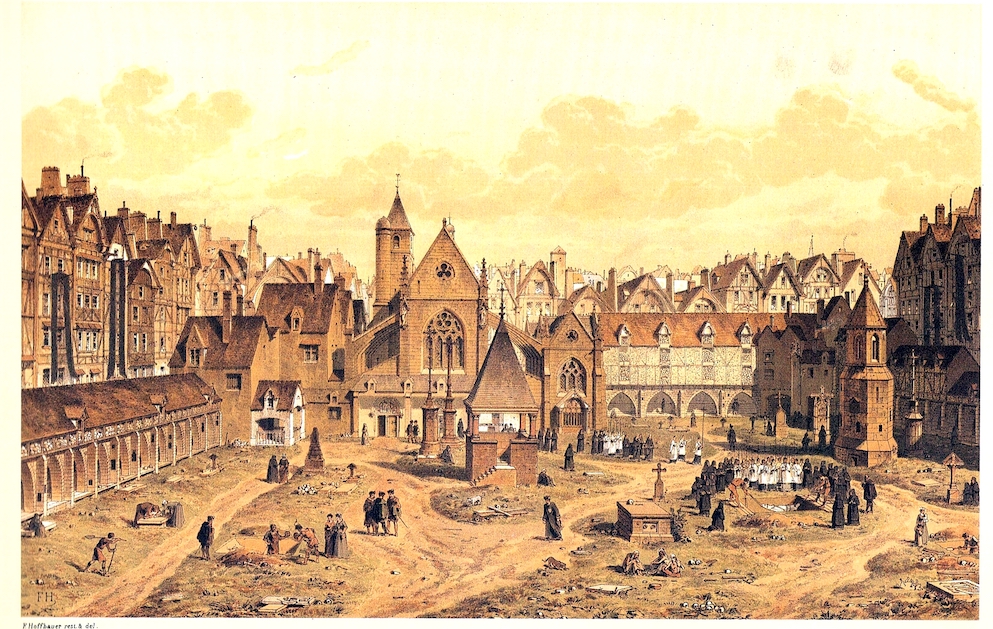
Largest medieval cemetery in Paris, the Cemetery of the Innocents was for 1,000 years the final resting place of millions of souls. A site with a remarkable history, of which today only a single vestige remains: the Fountain of the Innocents. Yet the invisible traces it left in the history of Paris are countless.
The Origins of the Cemetery
The area now occupied by Les Halles was chosen as a burial ground as early as the 7th century. There were several reasons for this. Roman law prohibited cemeteries within the city itself, and those traditions were still very much alive among the population. In addition, this stretch of meadows, lying directly on the city’s edge, bordered one of Paris’s most important thoroughfares: Rue Saint-Denis. Very quickly, just a hundred meters from the city walls, burials began to multiply—at first in a rather disorderly fashion. No enclosure, no real organization.
It was Philip Augustus, at the end of the 12th century, who gave the district a tremendous boost. The cemetery was enclosed by a three-meter-high wall and took its name—“the Innocents”—from the newly built church on Rue Saint-Denis dedicated to the Holy Innocents massacred by King Herod at the birth of Christ. From that point on, the cemetery was permanently enclosed within the city walls. For 500 years, Parisians would endure all the inconveniences this entailed.
It is worth noting that, in the Middle Ages, merchants often set up their stalls around cemeteries for their business transactions. Out of respect for the dead and fear of the divine, such places were thought to be free from fraud. This is how the district quickly transformed into a bustling commercial hub, which, together with Philip Augustus’s Les Halles, became the largest medieval marketplace in Western Europe. The origins of our neighborhoods can be surprising!
The Cemetery of the Innocents
Because of the limited space, individual graves were soon abandoned in favor of mass graves. In a vast pit about 5 meters wide and 10 meters deep, more than a thousand corpses were thrown each year. The pit remained open to the air until it was full, then it was covered over and a new one dug alongside it. Yet even this was not enough to cope with the ever-growing number of deaths.
In 1320, it was decided to build a charnel house: a cloister running along the four sides of the enclosure, topped with an attic. When a pit was filled, the bones were transferred into the attic so that the pit could be reused. And so it went, century after century, until the 18th century.
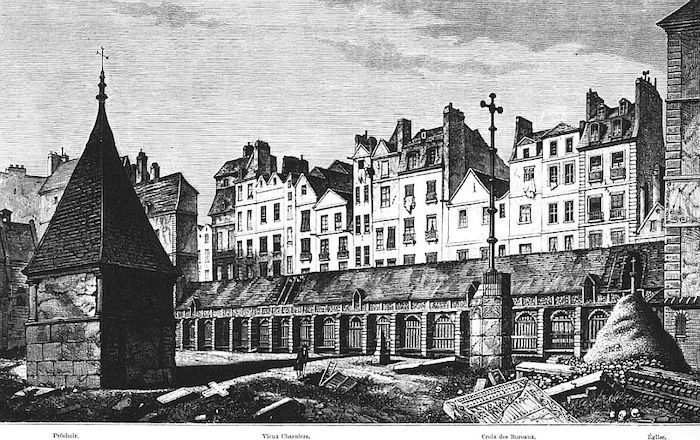

By the 16th century, the Cemetery of the Innocents had become the most pestilential place in Paris. This did not prevent drapers, booksellers, public scribes, and even prostitutes from plying their trade there. It also housed a reclusory—one of the most curious traditions of the Middle Ages—as well as a pulpit for preaching.
The cemetery continued to receive thousands of corpses each month until May 30, 1780, when one of the mass graves collapsed, spilling decomposing bodies into neighboring cellars. Faced with the risk of asphyxiation, the authorities decided to close the cemetery and fill in the remaining pits. Over its long history, it had served 40 generations of Parisians and absorbed more than 2 million corpses.
In 1786, the bones were transferred into part of Paris’s underground quarries, which are today known as the Catacombs.
The sanitary risks had simply become too great.