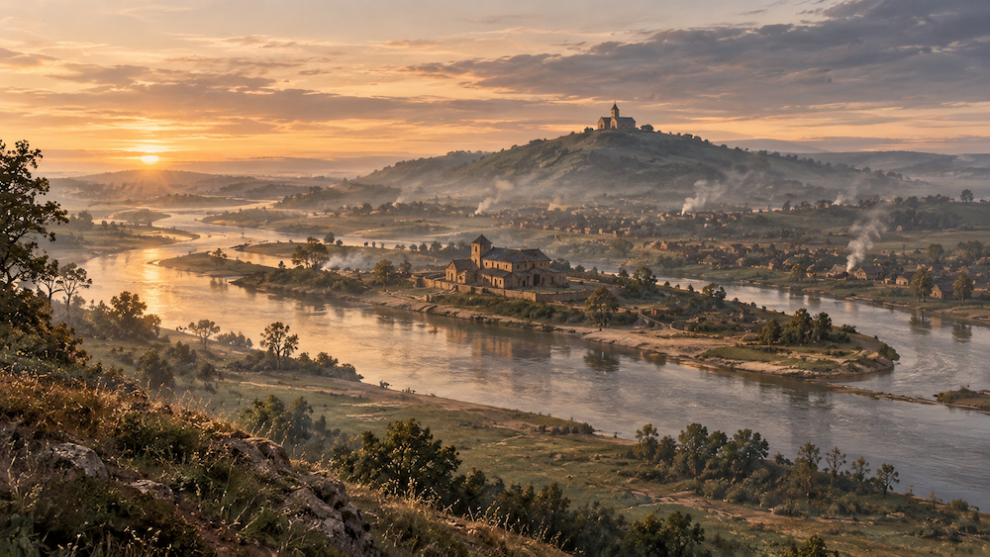
Having become the capital of the Frankish Kingdom in 508, Paris acquired a leading role in the early 6th century. Its importance was first and foremost political, as the royal court decided to establish its residence there. It also became a major commercial centre, thanks to its strategic network of roads and waterways. Although, unfortunately, no architectural remains from this period have survived, the Merovingian era laid the foundations for the city’s development over the centuries that followed. In short, this was the beginning of a long history…
Île de la Cité
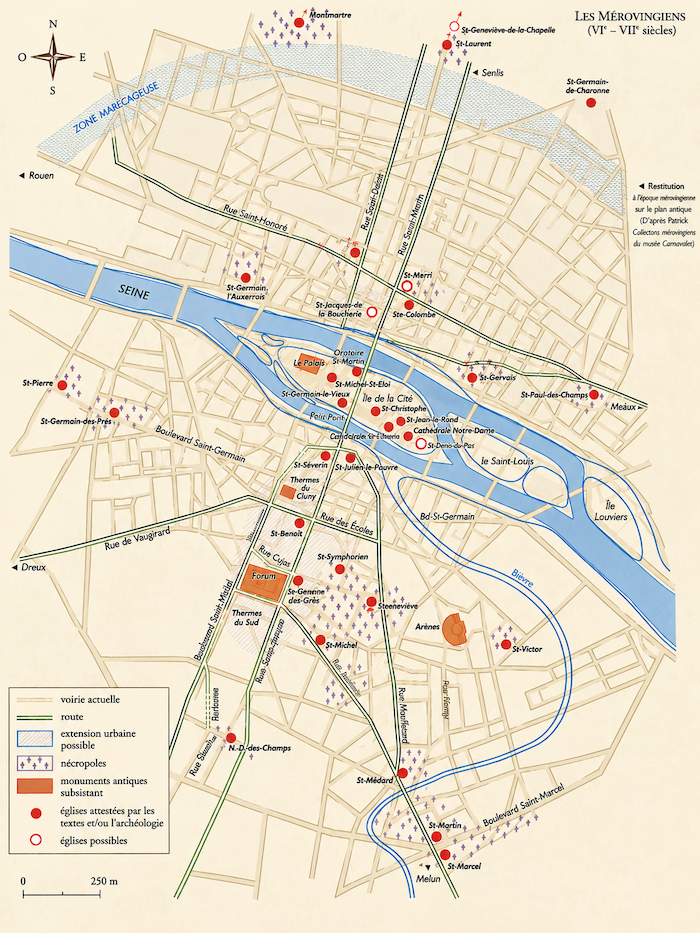
Protected by a defensive wall built during the Roman Empire (around the 3rd century), the Île de la Cité was connected to both banks of the Seine by two bridges: the Grand Pont to the north and the Petit Pont to the south. On the western side of the island, the Palace, where Emperor Julian and the Roman governors had once resided, became the residence of the Merovingian kings. To the east lay the centre of religious power, with Saint-Étienne Cathedral, a baptistery and a basilica. The cathedral was demolished in the 12th century to make way for the present-day Notre-Dame de Paris. Measuring approximately 60 metres in length and 36 metres in width, it was the largest church in Frankish Gaul.
Churches gradually sprang up across the entire island, reflecting the rapid spread of Christianity throughout the region. Some have been uncovered during archaeological excavations, while others are known only through written sources and therefore remain the subject of historical hypotheses.
he Right and Left Banks
Opposite the Île de la Cité, a suburb began to develop on the Right Bank. Churches surrounded by burial grounds were built, including Saint-Gervais and Saint-Germain-l’Auxerrois. However, urban development remained fairly limited. At the time, the Right Bank of Paris was still largely a marshland, formed by a former branch of the Seine. Flooding was frequent, and most of the population settled around small hills that offered protection from the rising waters, notably Saint-Merri, near what is now Beaubourg, and Saint-Gervais, behind the present-day Hôtel de Ville. Other “rural” churches, each surrounded by a cemetery, were built along the roads leading into the city.
On the other side of the river, the Left Bank was much more developed. The Romans had chosen this area as the site for the construction of the main monuments of the ancient city. However, as the Roman Empire began to decline, Parisians started reusing the stones from these buildings as early as the 4th century to construct a defensive wall around the Île de la Cité! By the 6th century, the Roman Forum and the Arènes de Lutèce had almost completely disappeared.
Outside the city, Childebert I, son of Clovis, founded the Abbey of Saint-Vincent-et-Sainte-Croix, which later became the Church of Saint-Germain-des-Prés. He was buried there, and the church subsequently became a royal necropolis. During the Merovingian period, it was one of the country’s most important religious sites.
The Surrounding Villages
A number of villages could be found in the surrounding area, including Montmartre, Charonne and La Chapelle-Saint-Denis. The name Montmartre comes from Mont des Martyrs (Mount of the Martyrs), as this is traditionally believed to be the place where Saint Denis, the first Bishop of Paris, suffered martyrdom. Archaeological excavations have revealed the existence of a vast necropolis on the site of what is now Saint-Pierre Church.