In two elliptical rooms of the Musée de l’Orangerie unfolds a water landscape dotted with water lilies, willow branches, reflections of trees, and clouds. A mural ensemble made up of eight panels offers a delightful moment of contemplation and a truly immersive experience.
For 30 years, Monet set up his easel in the heart of the garden at his residence in Giverny. He explored its shifting rhythms, the passage of time, and the cycles of nature. The Orangerie paintings result from a constant back-and-forth between direct observation and memory. Their monumental format, which made open-air work impossible, led the artist to paint large studies during the fine season, then rework them for the rest of the year in a vast studio built especially for the project. By creating the illusion of an “endless whole” and a “world without horizon or shores,” Monet shattered the norms of art.

No sky, no horizon, and entirely arbitrary boundaries. Empty of any human presence, the Water Lilies evoke a timeless nature. An all the more remarkable work given that Monet, suffering from double cataracts, was working almost blind in his final years.
The Water Lilies and the Orangerie
Offered by Claude Monet to France the day after the Armistice of November 11, 1918, the Water Lilies were installed at the Orangerie in 1927, a few months after the artist’s death. The work had no predetermined destination at the time of its execution. Monet envisioned the creation of a panoramic ensemble covering all the walls—a kind of unstructured promenade, inviting reverie and thought. He ultimately chose a double ellipse, a symbol of infinity. The choice of the Orangerie, situated between the river (the Seine) and the garden (the Tuileries), appeared in perfect harmony with the project.
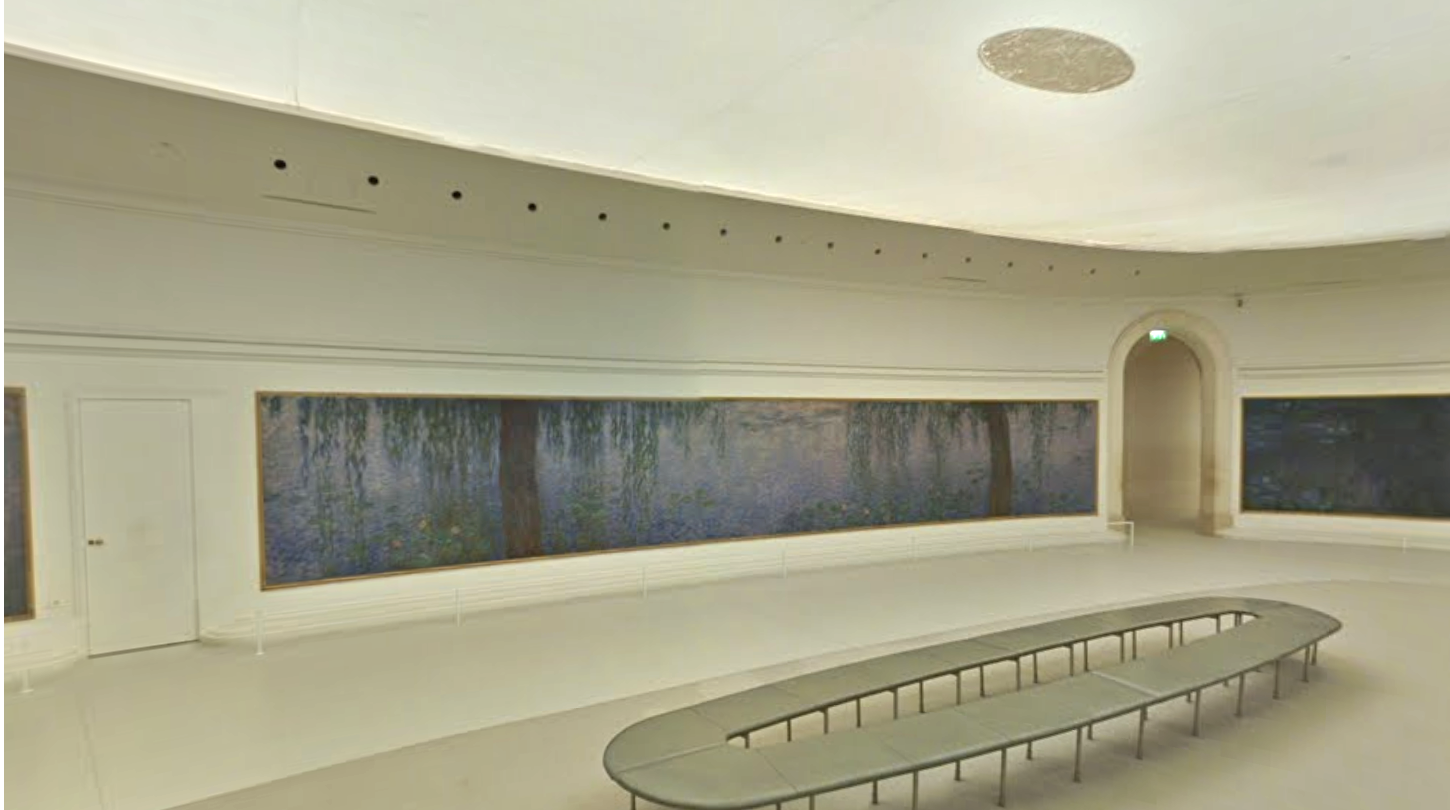
It is worth noting that the overall orientation is aligned with Paris’s east–west axis, that of the rising and setting sun. A total work of art centered on the cosmos!
When visiting the Water Lilies rooms, you will rediscover the key themes of Monet’s art: the passing of time, the expansion of space, the fusion of objects in overlapping fluid forms, and, of course, the need for an intimate connection with nature.
A living painting—not a spectacle to be observed from afar, but an environment into which the visitor quite literally immerses.