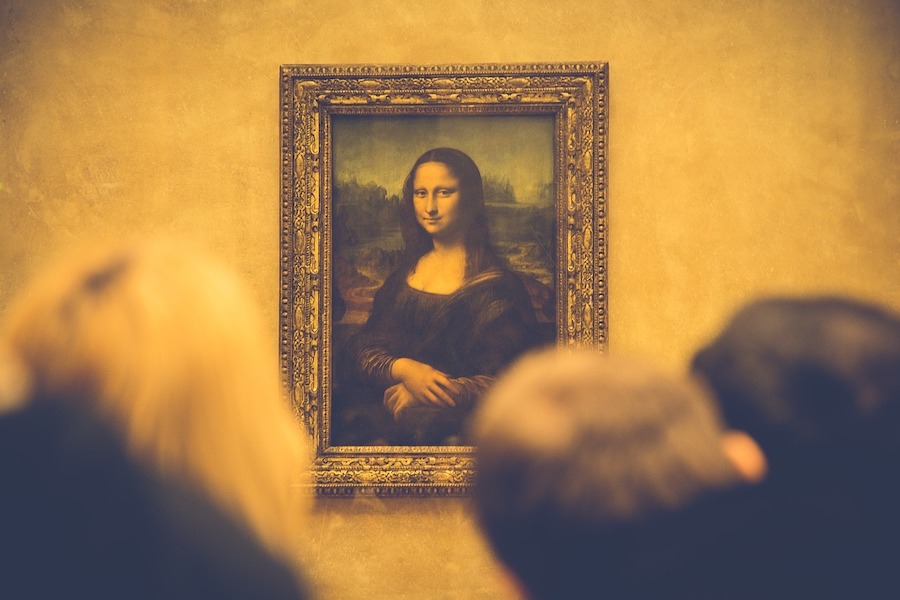
Being one of the most renowned paintings in the world does not come without peril.
Since its creation in the early 16th century, the Mona Lisa has had a life as mysterious as it is eventful—marked by travels, theft, and desire. But isn’t that also part of what contributes to the success of a masterpiece ?
Painted by Leonardo da Vinci, the most famous artist of his time, La Joconde is believed to have been commissioned by a wealthy Italian merchant, Francesco del Giocondo, who wanted a portrait of his wife, Lisa, to adorn their new home. Yet even today, doubts remain about this origin…
The painting was probably unfinished when Leonardo left Florence for Milan in 1506. Later, invited by King Francois I, he brought the artwork with him to France. Much like her identity, the history of the Mona Lisa and its journey to Paris remains shrouded in mystery. We don’t know whether Francesco del Giocondo ever had the pleasure of seeing the portrait, nor how it ended up in the royal collection.
When the French Revolution led to the creation of the Louvre Museum, the painting — then hanging in the Château de Versailles—was not initially selected for public display. It wasn’t until 1798 that it entered the museum. In 1801, the Mona Lisa made a brief stay at the Tuileries Palace in the apartments of Joséphine de Beauharnais, before returning to the museum. But the story doesn’t end there!
The Theft of the Mona Lisa
After a century of relative calm, the Mona Lisa was stolen on August 21, 1911.
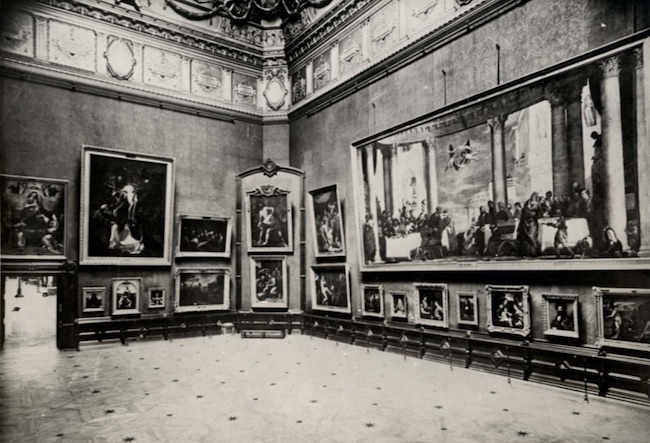
Hung in the Salon Carré of the Louvre, the painting was already enjoying a certain level of fame, protected by a pane of glass fitted into its frame.
On that day, Vincenzo Peruggia, an Italian glazier, slipped into the Salon Carré around 7 a.m. after spending the night hidden in a broom closet. He took down the Mona Lisa, removed it from its frame, and concealed the painting under his clothes before calmly walking out of the museum. He was no stranger to the task—he had been the one to install the protective glass a few years earlier!
The scandal erupted, and the director of the Louvre was forced to resign.
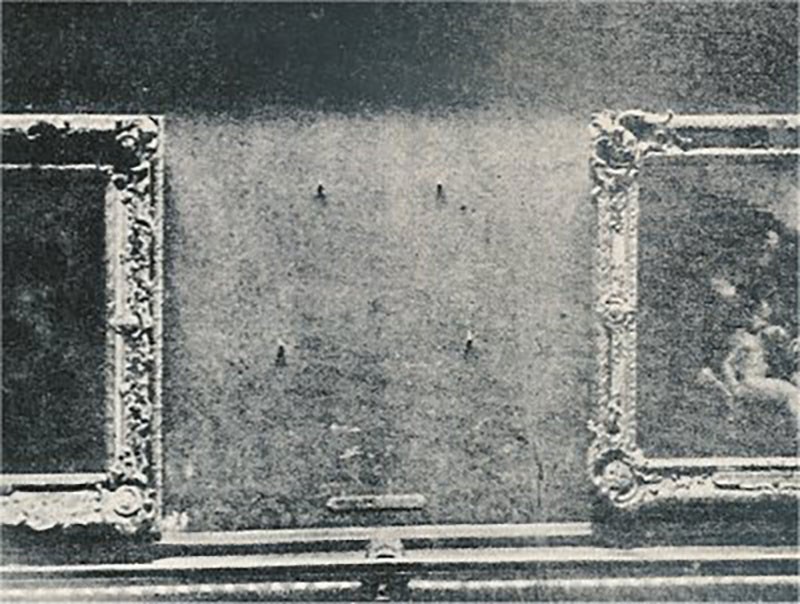
Crowds flocked to see the empty space where the painting had hung, and accusations flew in all directions. As a side note, Guillaume Apollinaire even spent a short time in prison, caught up in a case involving stolen statuettes from the museum that had been sold to Picasso.
While the French believed the painting was lost forever, it was in fact only a few kilometers from the Louvre—hidden under the thief’s bed in an apartment on Rue de l’Hôpital Saint-Louis, in the 10th arrondissement.
It remained there for two years, until Peruggia decided to return to Florence and tried to sell it to an art dealer—who promptly alerted the police.
During his trial, he claimed to have acted out of patriotism, believing the painting had been stolen from the Italians during the Napoleonic wars.
The Travels of the Mona Lisa
During both World Wars, the Mona Lisa was evacuated for fear of bombings and looting. Between September 27, 1938, and June 17, 1945, it was moved ten times, hidden in a crate marked only with the code “MNLP No. 0,” standing for Musée National du Louvre Peintures No. 0.
Chambord, Louvigny, the Abbey of Loc-Dieu, the Château de Montal… The Mona Lisa moved from place to place in response to military defeats, invasions, and occupations, until finally returning to the Louvre on June 15, 1945.
Its later journeys were more peaceful. From December 14, 1962, to March 12, 1963, it was exhibited in Washington, D.C., and New York, and then again in 1974 in Moscow and Tokyo.
Being the most famous painting in the world is no easy life!